career change for social change
- Kienna Qin
- Mar 9, 2020
- 5 min read

Ah, the career hunt. A long, grueling, and honestly discouraging process that we all have to go through at multiple points in our lives.
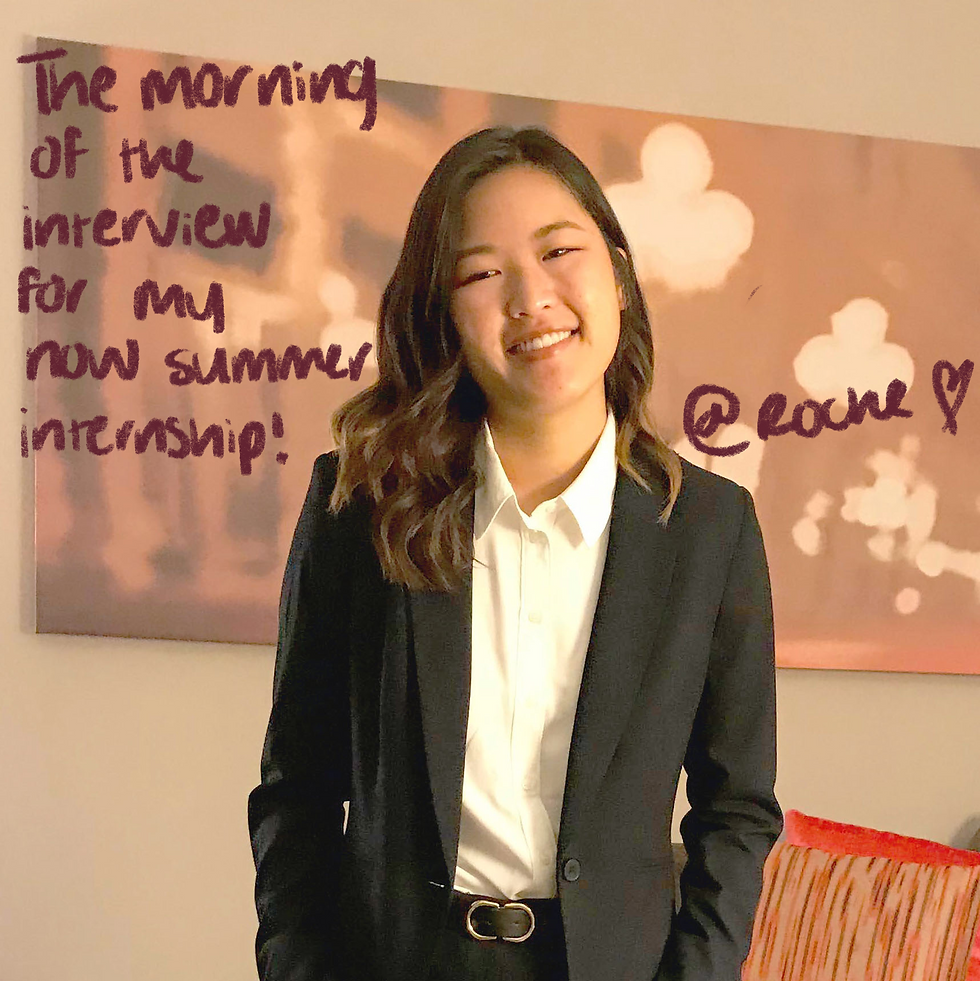
I have had a long journey with my career goals, to say the least. Last summer, the summer after my 2nd-year, I couldn't land a single internship. I was heartbroken and suffered through months of self-doubt and questioning whether I was good enough for any career. I was also rejected from the Public Health minor at UCLA, which had been my #1 goal the entirety of my sophomore year. Clearly, my 2nd-year was a challenging year to me. I really had to hone in on my career goals and think about what it was that I really wanted to do in the future, and these thoughts still continue to this day.
Right now, I think of my ideal job as working towards increasing health care access to marginalized communities, which, sure enough, is exactly what my friend Janet does today!

I met Janet during my first-year at UCLA through Hunger Project (HP), a student-led organization under the Community Service Commission that serves the homeless, housing insecure, and food insecure populations through volunteering and advocacy. Janet was a third-year at the time, and she directed two sites for HP: Monday Night Mission, an organization that serves hot food to homeless individuals on Skid Row, and Shower of Hope, an organization that provides free mobile showers and hygiene products to those in need.

As a naive and curious freshman, I became heavily involved in this organization, and it was easy to tell that Janet was one of the most active and dedicated board members to Hunger Project as well. I was so inspired by her work not only for HP, but also outside of the organization, as she also worked in two positions for companies that serve to provide health care to homeless individuals during the time we were at UCLA together.

It wasn't a surprise to me when last summer, Janet landed a job as a Care Management Community Coordinator at the San Francisco Health Plan, a company serving to provide accessible health insurance to improve health outcomes of various diverse communities in San Francisco. Right off the bat, I knew I wanted to interview Janet for this blog post. She was working in a position in an industry that I view as one of my dreams, and I wanted to find out if this dream could be a reality for me. So, without further adieu, here is...
THE INTERVIEW
Can you start off by giving a little bit of background on your position and company?
My technical title is “Care Management Community Coordinator” at the San Francisco Health Plan, but I’m basically a case manager. I have a caseload of up to 25 clients that I meet with regularly, and I help them in all facets of their life. My clients are pretty vulnerable and often have multiple chronic physical and mental health conditions, are unhoused, use substances, and frequently go to the Emergency Department. I help manage their conditions (i.e. connect them to a primary care physician, a specialist, or behavioral health), connect them to community resources (i.e. food, housing, Supplemental Security Income), and coordinate all of their care, so I’m the main point person for all of the providers in their lives.
I’ve personally struggled a lot in my career path with countless rejections from internships, crazy Imposter Syndrome, and never feeling like I’m successful or will be able to land my “dream job.” I was wondering if you experienced any of these downfalls before getting this position, and how you got through it?
I have struggled with perfectionism and fear of failure for a while now. I think being in a college environment, especially one like UCLA, it’s easy to compare yourself to others and constantly feel behind or like you’re not doing enough.
After college, I felt so much better because I was not constantly surrounded by my peers anymore. I’ve had time to just be with myself and go at my own pace and realized it’s totally fine to have nothing figured out.
Fear and rejection aren't things to be afraid of - they're necessary steps for growth. I also don’t think that you should be putting a huge emphasis on getting your “dream job,” because - take it from me - it won’t always be what you expect. It’s impossible to know if you’ll actually like something until you do it, so even if get rejected from your “dream job” (like I did), don’t worry! Learning what you don’t like is just as important as learning what you do like. You might stumble across something unexpected that leads you down an even better path.
What has been the most memorable experience of your job so far over the last few months?
My job can often feel discouraging, so I find it important to celebrate the small victories. Many of my clients have been traumatized by the medical system, and by the time I meet them, they’ve completely given up on doctors. One of my clients is extremely sick yet refuses to take any medications and doesn't trust doctors to help him. He used to get angry and yell when anyone suggested that he should see a doctor. Last week, he changed his mind and agreed to see a doctor - a big step. He has become more motivated to take care of his health. It makes me proud to see my clients overcome barriers and take steps toward improving their lives.
Going deeper, what has been the hardest part of your job in the last few months?
The hardest part is that I can only do so much for these people. Sure, I can show them the (limited) resources that exist, but the system itself still has so many problems. It feels like a band-aid solution instead of fixing the problem that’s causing all of these people to fall through the cracks and become homeless with multiple, unmanaged conditions.
Since we’ve both been involved with Hunger Project, do you have any insight on how your experience in Hunger Project shaped your career values and goals today?
Hunger Project shaped the trajectory of my entire life. Without Hunger Project, I don’t think I would have ever ended up in this field or known that I have a passion for working with this population. HP showed me how many people lack the basic necessities of life and has made me want to dedicate my life to social justice - in particular, economic disparities and health equity.
Lastly, I was wondering if you could give a quick piece of advice for me as someone who is incredibly passionate about social change - I often worry about how to find jobs like yours and successfully get them!
Just be genuine! When people see how much you want to work in this field, people will draw to you and it will open doors for more and more opportunities!
Reading about Janet's experience with her position inspired me even more to pursue a career in social change. She is making lasting, personal impact with her clients, which is exactly what I want to do. Over the course of the last few months, I realized I will never be truly happy if I don't work in a career that is personally meaningful for social change, meaning face-to-face interactions with individuals whose lives I can positively impact.
I was also shocked by how much Janet and I have in common before realizing the reason for these similarities is our experiences with Hunger Project! Like Janet, Hunger Project has completely shifted my life goals. It is because of HP that I know I won't be fulfilled in a career that isn't geared towards social change. This organization I stumbled upon my freshman year at UCLA has completely altered my life, and I am so grateful for that.

I am so glad I was able to hear Janet's advice and intake on her career. This experience gave me an intimate look into what it would be like to work in my "dream job," and I can say with confidence that it has pushed me to make the decision to fully turn my passion for social justice into a career.

With love,
Kienna <3


This piece was absolutely lovely! I love that you imbedded your interview within a greater reflection on your personal and professional development. The thematic nature of your future goals gave your interview weight and your added bold sections were the cherry on top to a well-structured blog. The pictures were a beautiful addition and helped bring your story to life!
I loved your blog! I really enjoyed how insightful both your reflection and Janet's advice are. The thing I loved the most would be the advice on Imposter Syndrome and feeling like we are not perfect enough. I think this is something everyone suffers once in a while because we go to such a big school and live in such a diverse and lively city. As a freshman, I've been feeling pressured to do well, and seeing how perfect other people are can easily influence my thoughts and perceptions, so I really appreciated this blog! It's okay to have these thoughts, but at the end of the day, it's just a part of growing. Thank you for these wise words…
I really enjoyed this blog! I love how reflective and personal it is and how you track your own growth and weave it in with the story of the person you interviewed. I also like the personal photographs that you have included–they really bring the story to life. It is so interesting to hear about the work that Janet does and that you hope to do in the future; it is certainly a very noble cause.